Team building around collaboration and breaking down silos
You don’t break down silos with a simple task or a short speech. You do it with an activity where teams feel what collaboration requires: aligning, taking ownership, and looking beyond their own part.
Many managers are not looking for a team building “just to do something fun”. They are looking for a moment that brings enjoyment, but also makes something visible.
How do teams work together? Do people stay in their own corner? Is information shared or kept? Does everyone take ownership, or do people wait for someone else to decide?
These are familiar questions, especially in organisations where departments, countries, sites or project teams need to learn to collaborate better.
A good team building does not solve this with a single magical insight. But it can make the dynamics very concrete. Not in a meeting room, but in action. With time pressure, materials, choices, discussion, mistakes and a clear shared goal.
At Moodmaker, we often use formats such as Chain Reaction and Before Mars. Both revolve around collaboration, but in very different ways.
First: what do we mean by silos?
Silos rarely appear because people do not want to collaborate.
Often it is more subtle. Every team has its own priorities. Every department has its own planning, language and pressure. People optimise their own part, while the bigger picture fades out of view.
During a team building, this can happen very quickly.
A group enthusiastically builds its own part, but checks too late whether it connects to the rest. Someone has useful information but does not share it immediately. A team decides quickly but forgets the impact on other teams. Or everyone works hard, but no one safeguards the whole.
These are exactly the moments where collaboration becomes tangible.
Chain Reaction: collaborating towards one visible goal
Chain Reaction is a strong choice when you want to strengthen collaboration in an accessible, energetic and hands-on way.
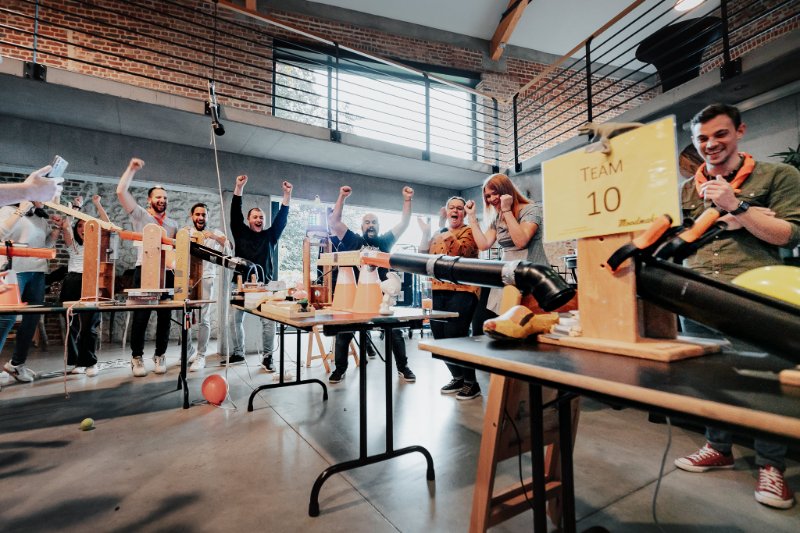
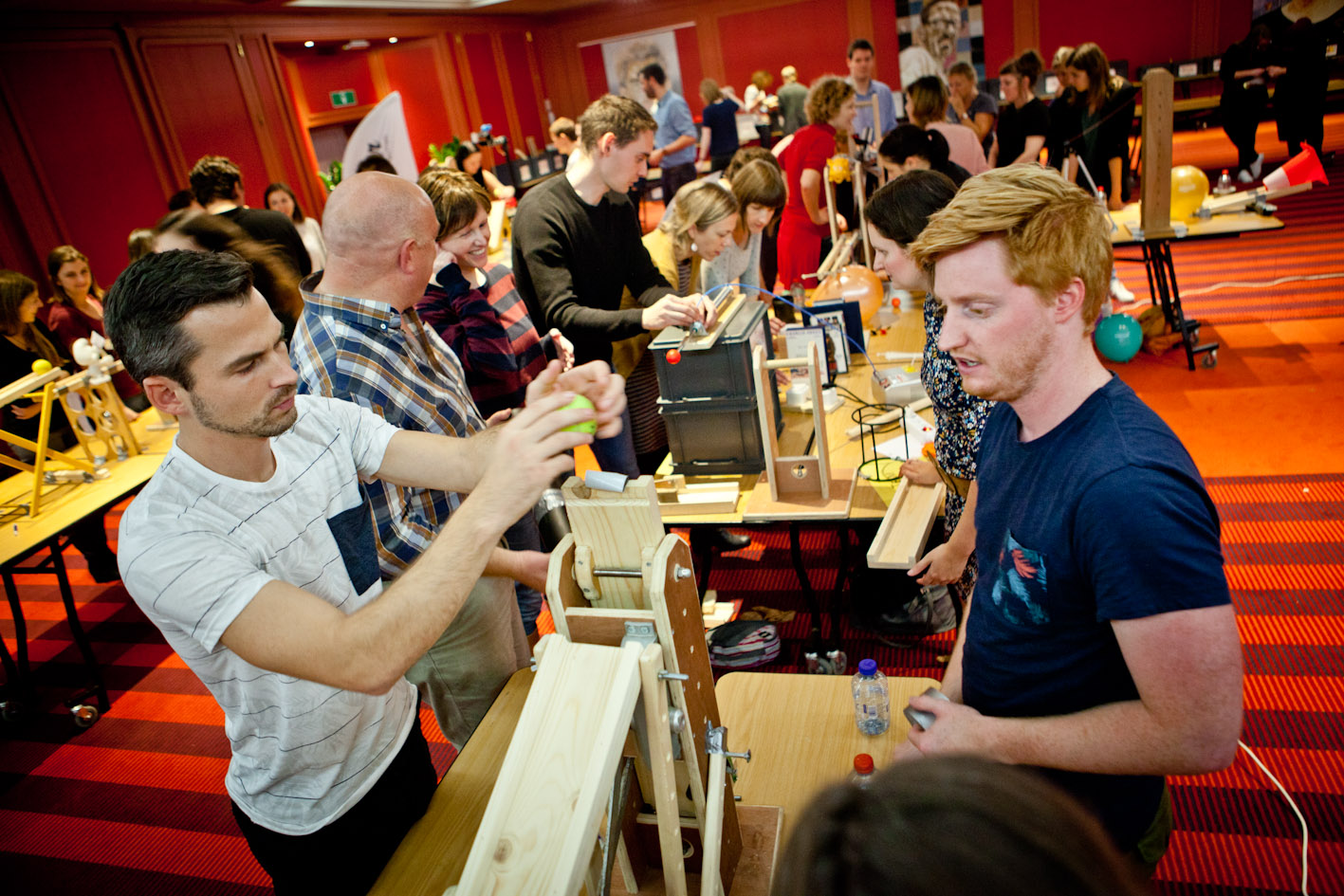
Teams build a large chain reaction together. Every element must work, but it must also connect to what comes before and after. This immediately makes collaboration concrete: you cannot build only for your own part. The whole matters.
This makes Chain Reaction particularly suitable for groups that:
want to get to know each other better;
seek more connection between teams or departments;
want to stimulate creativity and discussion;
want an active team building with a clear collaborative layer;
want a shared final moment full of energy;
also work for teams that do not know each other very well yet.
It is fun, visible and low-threshold. At the same time, there is a lot in it: alignment, testing, improving, communication and taking responsibility for the whole.
Not through theory, but through action.
Before Mars: collaborating in complexity
Before Mars goes a step further.
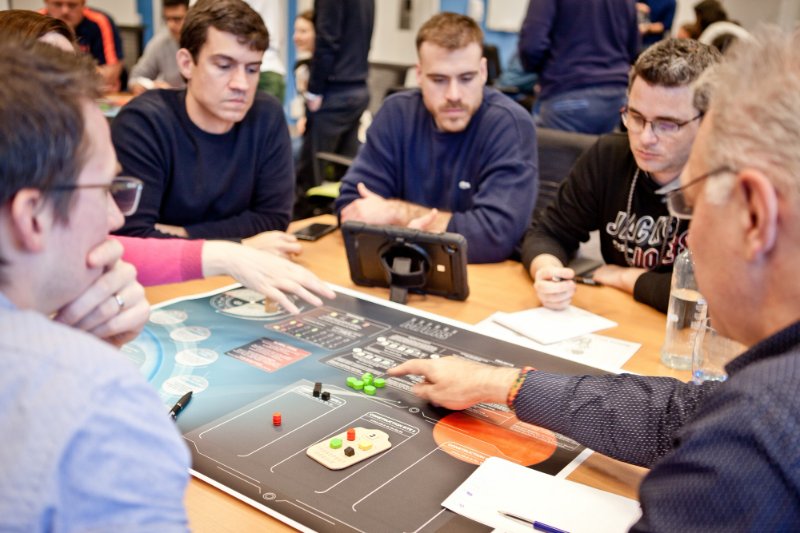
In this business game, the team receives a complex mission: safely transporting a group of people to Mars. This requires strategic thinking, sharp choices and collaboration under pressure.
Where Chain Reaction is mainly physical, creative and hands-on, Before Mars focuses more on complexity, information processing and decision-making. Teams need to plan, adjust, prioritise and deal with the consequences of their choices.
Before Mars is especially suitable when you want to work on themes such as:
cross-functional collaboration;
ownership;
communication under pressure;
strategic thinking;
decision-making with incomplete information;
collaboration between interdependent teams.
It remains a team building, not a traditional management training. But the underlying layer is deeper. For teams that enjoy being challenged, this can be a real strength.
Easy fun versus hard fun
A simple way to describe the difference: Chain Reaction is “easy fun”, Before Mars is “hard fun”.
Chain Reaction quickly creates energy. People build, try, laugh, test and celebrate the final result together. The activity feels light and accessible, but clearly shows collaboration in action.
Before Mars requires more thinking. The fun lies not only in the game itself but also in the challenge. Teams are confronted with choices, pressure and complexity. This makes it more intense, but also richer for groups that want more depth.
Both are valuable. The right choice mainly depends on your group and your objective.
When to choose Chain Reaction?
Choose Chain Reaction if you are looking for an activity that:
brings a lot of energy and enjoyment;
suits large groups;
quickly builds connection between participants;
combines creativity and collaboration;
also works for teams that do not know each other very well yet;
remains accessible to a broad audience.
Chain Reaction is often a safe and effective choice when you want everyone to participate and the group feeling to grow quickly.
When to choose Before Mars?
Choose Before Mars if your group is ready for more depth.
For example when you want to:
strengthen collaboration between departments;
make ownership and decision-making more visible;
add an insightful layer without a classic training;
work with managers, project teams or high-performing teams;
generate material for reflection afterwards.
Before Mars requires more focus and engagement. But precisely because of that, it can reveal a lot.
And if you are unsure?
The question is usually not: which activity is “the best”?
The better question is: what do you want your team to experience most?
If you want people to build, align and celebrate together in a simple and positive way, Chain Reaction is likely the right choice.
If you want teams to make decisions under pressure, share information and experience how collaboration becomes more complex when things get tense, then Before Mars is a better fit.
In both cases, the starting point is the same: people need to feel like joining in. The fun comes first. Only then does the deeper layer emerge.
Collaboration only becomes interesting when you can see it happen
We talk a lot about collaboration. But in a good team building, you actually see it happen.
Who takes initiative? Who connects the pieces? Who keeps oversight? Who stays in their own zone? Who shares information at the right moment? And who moves the whole forward?
This is what makes activities like Chain Reaction and Before Mars so valuable. Not because they transform a team in half a day, but because they make visible—in a positive and energetic way—how a group collaborates.
And that is often exactly the starting point a team needs.
Activities Related to This Insight
Do you want to make collaboration, communication or silos visible? These formats help teams experience what happens when everyone has to focus on their own part while also keeping sight of the bigger picture.