Should You Let Teams Choose or Assign Them in Advance? How to Get Your Team Building Off to a Smooth Start
Should you assign teams in advance or let participants choose for themselves? The best answer depends on your objective, your group, and how much social tension you already sense beforehand.
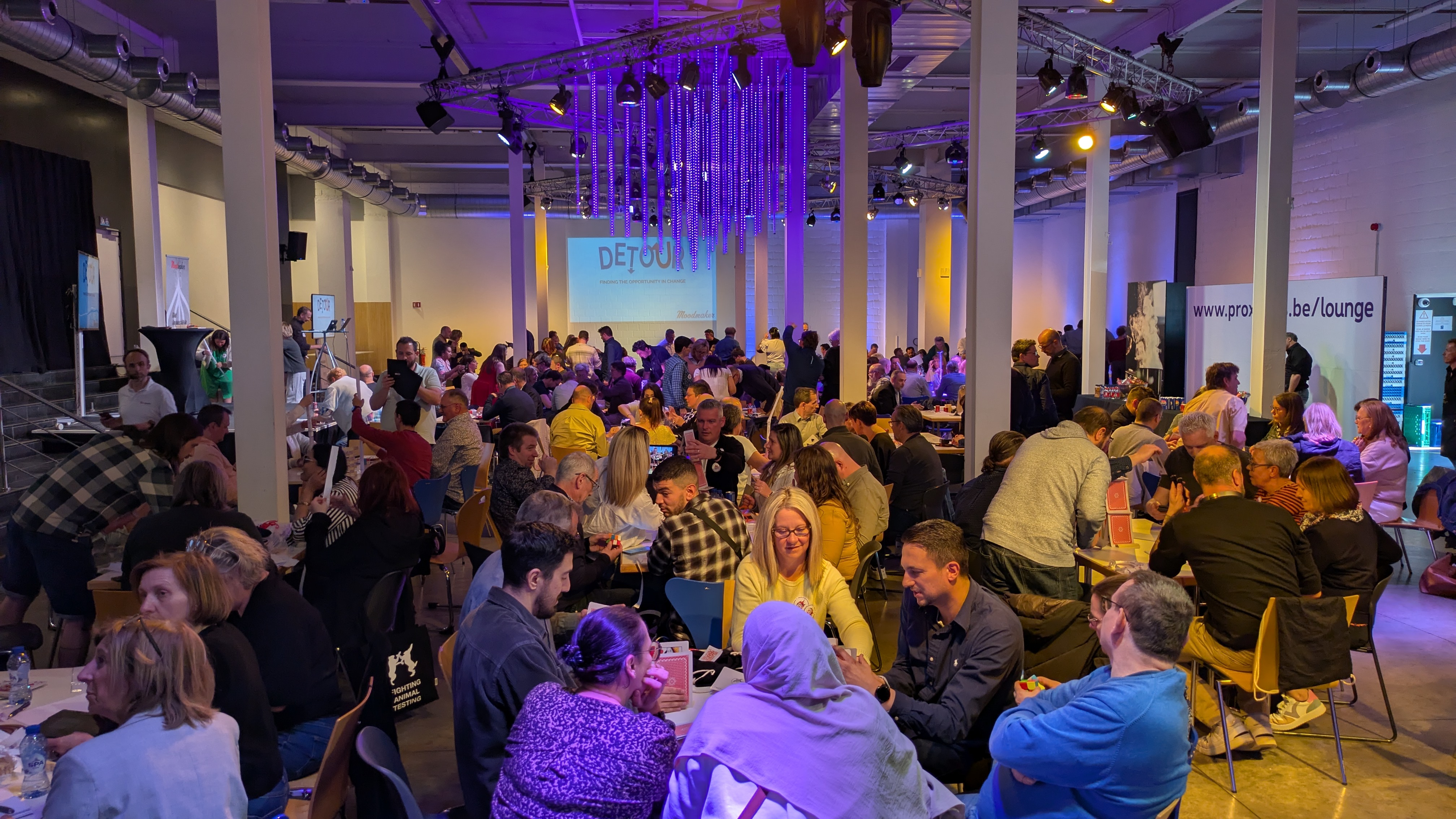
It may seem like a small detail... until you start organising the programme in practice.
Who should be on which team? Do you let colleagues form their own groups? Do you assign everyone in advance? Or do you use cards, colours or numbers on the day itself?
At Moodmaker, we hear this question all the time. And for good reason. Team allocation does not determine everything, but it does set the tone from the very beginning. Sometimes the goal is simply to help people start in a relaxed way. Sometimes you specifically want to mix departments. And sometimes you mainly want to avoid the same four colleagues spending the entire afternoon together again.
There is no one-size-fits-all answer. There is, however, a smart choice for every situation.
If the goal is mainly fun and relaxation
When the main objective is fun, energy and connection, you can keep team allocation fairly light.
For smaller groups or teams who already know each other well, allowing people to choose their own teams often works perfectly. Participants feel more comfortable from the start. They laugh more easily, naturally gravitate towards familiar colleagues and feel less hesitant about joining in.
And that is perfectly fine. A team-building activity does not always need to begin with a social experiment.
If your goal is simply to create an enjoyable afternoon without unnecessary complications, letting people choose for themselves is often the most natural option.
If you want people to mix, assign teams in advance
Do you want people from different departments to get to know each other better? Do you want to mix new employees with experienced colleagues? Or have you noticed that the same groups always form within the company?
Then assigning teams in advance is usually the stronger option.
Not because organisers need to control everything, but because it helps give chance a little push in the right direction.
Without guidance, people tend to make safe choices. That's human nature. Sales stays with sales. Marketing stays with marketing. The quieter colleague joins someone they already know. For a regular lunch, that's not an issue. For a team-building activity, it can be a missed opportunity.
A thoughtfully mixed team can lead to unexpected combinations—and that is often where the best conversations begin.
Avoid creating the perfect puzzle
Assigning teams in advance does not mean you need to create a psychological profile for every colleague.
That is often where things become unnecessarily complicated. You start with good intentions and end up with a spreadsheet sorting everyone by personality, role, age, experience and sensitivities. In most cases, that is simply not necessary.
Keep it simple.
Consider a few clear criteria:
mix departments;
spread managers and team leaders across teams;
avoid grouping all strong personalities together;
don't place all new employees in the same team;
avoid combinations you know are genuinely difficult.
Very often, that's all you need.
A team-building activity can be lively and dynamic. A team does not need to be perfectly balanced in order to work well together.
The hybrid approach often works best
In practice, the best solution is often a combination of both approaches.
You create the teams in advance, but keep it casual. You do not communicate it as if it were a strategic reorganisation. You simply say:
"We've mixed the teams a little so everyone gets the chance to work with different colleagues."
That's it.
For larger groups, this is usually the most practical option as well. Everyone knows where they need to be. The activity can start smoothly. And you avoid participants wandering around trying to figure out where they belong.
For smaller groups, you can also mix people on the spot using colours, cards or numbers. It feels playful and fair. It also removes the pressure for participants who find it uncomfortable to choose a team themselves.
When is it better not to let people choose freely?
Allowing people to choose their own teams may seem friendly, but it is not always the easiest option.
It is usually better to avoid free choice when:
there are many new employees;
clear cliques already exist;
some participants are less socially confident;
you intentionally want to mix departments;
tensions exist between teams;
your activity is designed to encourage collaboration between colleagues who do not know each other well.
In these situations, "just choose your own team" can actually create discomfort. Some people quickly find a group. Others are left standing on the sidelines. As an organiser, you usually notice this immediately.
In those cases, assigning teams in advance is not strict. It is considerate.
When is letting people choose a good idea?
Allowing people to choose works well when:
the group is small;
everyone already knows each other;
relaxation is the primary goal;
there is little internal tension;
the activity is short and accessible;
you do not have a specific learning or networking objective.
In those situations, there is no need to make things more complicated than they need to be.
Sometimes the best organisational decision is simply to let go.
Our simple advice
Don't start with the question:
"What is fair?"
Start with the question:
"What do I want to happen?"
If you want comfort and a smooth start, let people choose.
If you want new connections to form, assign teams in advance.
If you want both, create the teams beforehand but keep the approach relaxed and human.
A successful team building activity does not start with the perfect team allocation. It starts with creating an environment where people genuinely want to participate. Team allocation should support that—not make it more complicated.
Activities Related to This Insight
Do you want to mix people strategically or let them start in a relaxed way? These formats quickly reveal collaboration and group dynamics.